
Ideate Early and Often
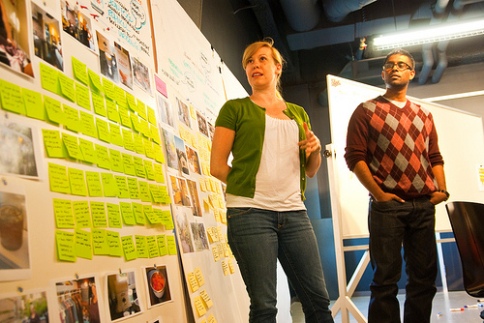
We’ve spent much of the past four days ideating, and that may surprise some folks who save ideation for the end of their creative process. As many of you know, ideation is the act of creating solutions using generative ways of thinking. And we think that’s something worth doing all the time.
When we ideate throughout the process, we’re not just simply aiming to come up with business ideas that we could launch. We also turn to ideation as a way to transform our implicit understandings of the abstract spaces of insights, frameworks, needs and directions we’ve discovered into something concrete. By analyzing what we create, we can discover new patterns, raise new questions and generate new ideas.
Our MBA friends from the Rotman School of Management have really approached each of the ideation sessions enthusiastically, but they’ve also found that not all ideation sessions are created equal for all people. Some folks work better in groups, others prefer to go solo. Some students did well in rapid-fire ideation sessions, while others took their time to warm-up to new ideas. Watching them work has reminded us that it’s important to mix things up. If you ideate in the same way and with the same tools every time, you’ll probably unwittingly limit your creative powers.
JLL2010 Photo Shoot
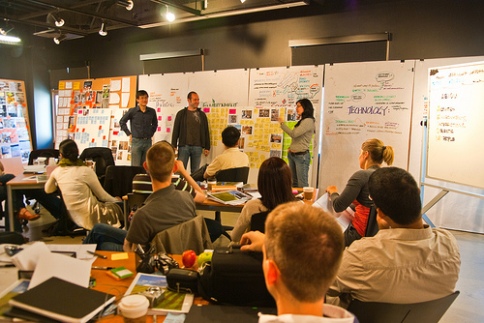
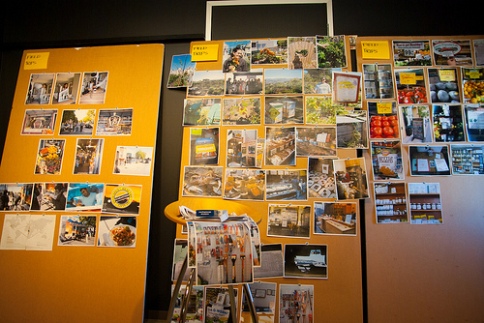
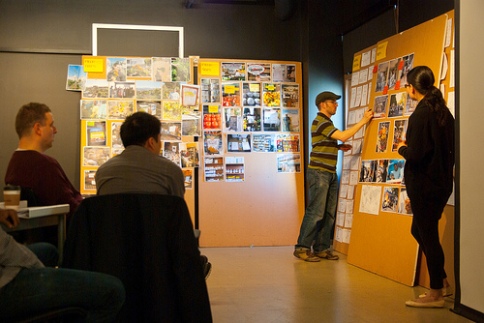
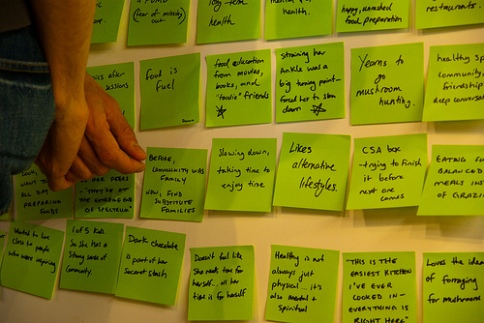
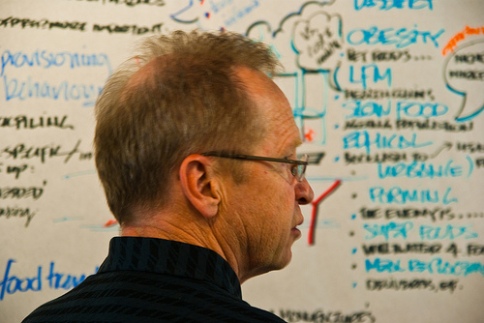
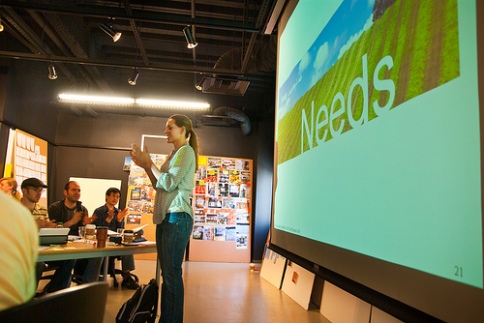
We’ve received a few requests to share more photos from the Rotman + Jump learning lab, and we’re happy to oblige. Below are pictures from days 1 through 3 of the lab. They highlight our photo collections from the field, our ubiquitous use of sticky notes and the rapidly filling performance space.
Let the Idea Nuggets Emerge
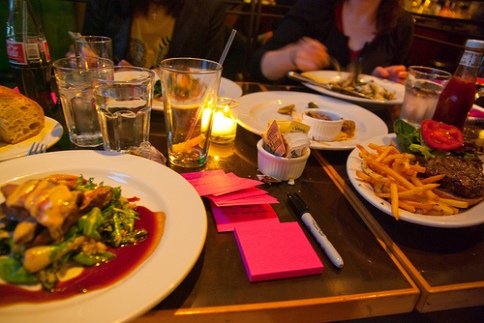
As we walked through Jump’s Performance Space earlier today and looked at all the boards filling up with pictures from Monday and Tuesday’s field trips, we decided to pick out a few nuggets and surprises to share. Without further ado, here’s some food for thought (no pun intended):
The Oasis Factor – Especially in urban settings, people turn to food related products and services for an emotional retreat. These retreats may include a roving street cart, urban gardens, or a well-known, friendly shop.
The Importance of Community in Gardening – Communities are coming together and forming around gardening in surprising and boundary-defying ways. On any given day at an urban community garden, you might have a CEO and a fireman working side-by-side to plant crops. What’s more, these communities are self-policing. They create their own rules for everything from bartering and trading amongst each other to revenue and profit sharing, and even build their own norms for dealing with vandalism and theft.
Is Organic Enough? – This is a topic that demands further research, and we’re certainly not experts yet. However, in a world where organic food gets all the big press, it was eye-opening to meet so many folks concerned with other things: the ethical treatment of animals, the livelihood of local farmers, reliance on fossil fuels in production, etc. This point raises several questions: Does organic always equal ethical? And are there other unmet needs around ethically produced food?
What Supply Chain Strategy Do You Need? – As we noted this morning, we couldn’t help but notice the stark differences between food shops in Palo Alto and East Palo Alto, two towns separated by less than one mile in the largely affluent San Francisco Bay Area. Looking at the fresh produce and fruit on the shelves in higher-end groceries in Palo Alto, we didn’t spot a single item that showed any sense of aging or rotting in the store. If these items don’t sell immediately, do these shops send them back into the distribution network? And as unsatisfactory as this may sound, do these rejects end up in places like the shops in East Palo Alto? That’s unlikely, but potentially true.
Does “Fresh” Promote More than Just Freshness? – We are wondering whether access to fresh food encourages exploration and experimentation. Shoppers in organic grocery stores, like Bi-Rite in San Francisco, seem inspired to ask questions about cuts of meat, cheeses, and fruits that they don’t know anything about. And that makes sense to us. Freshness itself is attractive, and even foods that are foreign to us seem like they might be worth the risk when they’re perfectly ripe.
Stories Have Value – At several boutique and high-end food markets, we noticed an emphasis on telling the stories behind food items. These stores used signs and shelf space to share information about farms, communities, countries of origin, traditions, nutrition, etc. And knowledgeable staff seem more like teachers and storytellers than clerks. We think that the richness of these stories may explain part of the premium these stores can charge.
Sustainable Isn’t Enough if it Isn’t Easy – One thing that struck us during our trips to San Francisco and Palo Alto was the growing use of CSA boxes – crates of home delivered fruits and vegetables from local farms. Looking deeper at some of the branding and product messaging that these organizations use, it seems that ease-of-use is almost more important than the freshness and variety of the produce. Home delivery (straight to your door!) trumps all.
The Anti-Commerce Slant – Many of the small, successful food shops we visited toned down the business aspects of their ventures. Signs were clean and simple, branding was minimal, and packaging was slight. Bottom-line: bright neon signs are out.
Learning to See with New Eyes
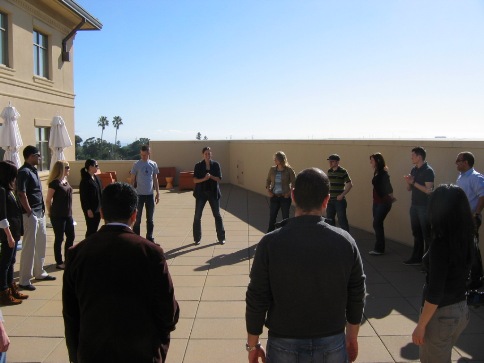
Yesterday’s lectures and field research focused on the power of observation, and we aimed to provide our visitors from Rotman with the tools necessary for seeing the world through new eyes. We found motivation in the words of Marcel Proust, who once said, “The only real voyage of discovery consists not in seeking new landscapes, but in having new eyes.”
Observations can take many forms, and we should always be mindful that we are not limited to seeing the world through only a few of our senses. You can experience the world by watching, listening, touching, doing, buying, reading, reflecting on past experiences and much more.
Putting our researcher hats on, we can practice seeing the world with new eyes by asking open-ended questions, walking in others shoes, purchasing competitive and analogous solutions, mining both core and peripheral information, and acknowledging that we may know more then we think we do.
To put these learnings into action, we spent the evening conducting in-home, qualitative interviews with people all around the Bay Area. Our goal was to better understand what “health” and “healthy eating” means to them, and what role it plays (or doesn’t play) in the larger context of their life. We’ll be debriefing our experiences this morning as an entire team, but we can already say that we met with some really interesting folks.
People like the gentleman we spent time with in San Francisco who notes that exercise and health is very important to him – taking 100 mile bike rides on the weekend and baking his own bread for example. Yet, he’s also a huge fan of travel, desserts and experimentation. He even went to K.F.C. recently to try their new “double-down” – not exactly the epitome of healthy eating.
Finding Opportunity Where Tensions Exist

We’d like to take a minute to revisit some of our experiences from this Monday:
A group of us drove around East Palo Alto on Monday afternoon looking for a Safeway. We were unsuccessful. A classic example of a “food desert,” East Palo Alto is a community where affordable nutritious foods are largely inaccessible. Big supermarkets are rare, while fast food is abundant, inexpensive and accessible. Yet, not a mile away on the other side of Highway 101, farmer’s markets, organic produce, olive oil from around the word and high-end cuts of meat are everywhere. There’s also an abundance of top notch restaurants featuring global cuisine.
But in East Palo Alto, here’s a taste of what we saw: In most stores, there was a greater variety of donuts than fresh vegetables. And the vegetables we did see? Most were in rubbish bins rotting away. None of us had ever seen a pile rotting vegetables inside a store, and the effect was immediate. We all began to think twice about buying anything perishable.
Organizations like East Palo Alto’s Collective Roots are trying to change this disparity by engaging youth and communities through sustainable programs that impact health, education, and the environment. But one nonprofit organization isn’t enough. What other opportunities are there to bridge the gap between these two worlds? How can these groups develop empathy for one another? And what role might a business play in bringing healthy eating to food deserts like East Palo Alto? These are just some of the questions that have emerged over the past two days, and will use these prompts to focus our thinking as we begin to generate new business ideas.
From Kick-Off to Ideation
The first day of the Healthy Eating Learning Lab with the Rotman School of Management is complete, and it certainly was action-packed. We started with an early morning scrum to get everyone excited, smiling, and on the same page, and then shifted right into a couple of lectures and hands-on activities.
To help get our heads around how to create healthy-eating businesses, we first discussed health care, and used a mind-mapping exercise to get lots of existing knowledge out of our heads. For some, mindmapping came naturally, while others kept pushing themselves to look for new, surprising connections.
We also got to talk in-depth about food. The Rotman students came prepared, having already conducted a round of secondary research on emerging trends in food and eating. That preparation allowed our conversation to move quickly away from the obvious trends, and we really got to explore what we think might be happening next, and the impact that these trends may have down the road.
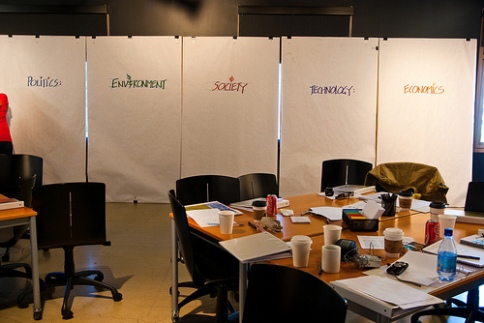
To help us gather, condense and organize all of the information we have, we’ve placed five big boards up in the Jump Performance Space. These will be our collection spaces for insights and observations as we move forward. The great news is that we already have a massive amount of information, and we haven’t even started field interviews yet! Take a look back at the @jumplearninglab Twitter feed to see a recap of a few of the coolest ideas that were coming out of yesterday’s conversations.
As you’ll remember, we also did some field research in San Francisco and Palo Alto yesterday afternoon. However, before we headed out, we conducted our first ideation session. We’ll write more about these ideation sessions later, but it’s always fun to put pen to paper and get visual. Some ideas are probably not feasible, and a few are certainly wacky, but without a doubt, a few of the ideas are beginning to have the kernels of insight and brilliance that we’ll want at the end of the week. Exciting beginnings!
Hitting the Road
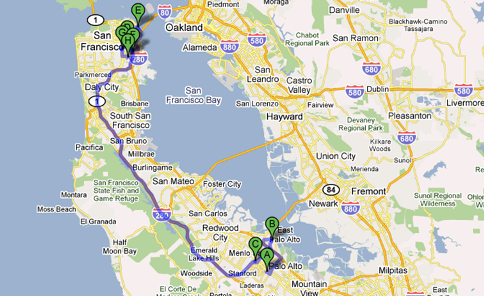
After several lectures today about the innovation process, and some active discussions about the intersection of trends in food and personal health, we’re now splitting up into four groups for some real-world learning.
Our projects here at Jump almost always involve trying to understand how a client might be able to grow its business in an uncertain future. And we do many different things in search of inspiration about what this future might look like. But one of our favorites is to get out of the office and see the real people and organizations that are pushing the bleeding edge of whatever category we’re studying.
Fortunately for this Learning Lab, the San Francisco Bay Area is home to many places, environments, and entrepreneurs who are doing things at the fringe of the food economy. So on this Monday afternoon, we’re going to see some of these innovators and places with our very own eyes. Here’s where we’re headed:
Common Ground – An “Organic Garden Supply and Education Center,” we’re excited about Common Ground because it is doing great work to enable the Palo Alto community to bring organic food into its homes in the freshest way possible: by having residents grow it themselves. Common Ground is one part retail outlet, one part demonstration garden, one part non-profit community resource, and all together a collection of folks who care deeply about health and their neighbors. To learn more, click here.
Ferry Building Marketplace in San Francisco – Committed to exposing San Francisco residents to a vibrant artisanal food community, the Ferry Building plays host to an eclectic assortment of entrepreneurs and small businesses who sell fresh farm products and other high-quality, prepared foods. While we unfortunately can’t introduce our Rotman friends to the uber-popular Farmer’s Market that shows up at the Ferry Building on Tuesdays and Saturdays, we’re looking forward to meeting folks at several independently owned and operated businesses that call the marketplace their everyday home. To learn more, click here.
Potrero Hill Community Garden – Potrero Hill plays home to one of the only open and unlocked community gardens in San Francisco. (There are 40 community gardens operated by the San Francisco Recreation and Park Department, but most are closed to outsiders.) Its 50 plots are regularly maintained by residents of Potrero Hill, and it boasts everything from fruits and veggies to a carefully managed collection of bee hives. We’re lucky to be speaking with the Garden Master, who’s going to show us around and teach us about community gardening. To learn more, click here.
Smitten Ice Cream – The best entrepreneurs find new ways to surprise customers, and Smitten Ice Cream has blown us away. Picture this: you see the basic ingredients needed for ice cream in front of you, as fresh as can be, and then watch in wonder as a liquid nitrogen blast creates a custom scoop just for you. And we’re equally as impressed by the product and the experience as we are by the buzz that they’ve created through visceral, grassroots publicity efforts. No one can help but pay attention when this magical freezing machine rolls up to Dolores Park on the on top of an iconic Radio Flyer wagon. Can’t wait to hear more from them in person. To learn more, click here. Or follow @SmittenIceCream on Twitter.
East Palo Alto – Palo Alto and East Palo Alto are two completely different worlds, separated only by the lanes of Highway 101. Much has been written about East Palo Alto as a “food desert,” a place where it’s difficult, if not impossible, to have access to fresh food without driving out of town. We’re going to bring the group to both East Palo Alto and its western sister city, so that we can compare and contrast retail experiences. To learn more click here.
Bi-Rite Market and Rainbow Grocery Cooperative – We’re going to swing by both the Bi-Rite and Rainbow Grocery in San Francisco. These spots are quite popular for city residents, and display a deep emphasis on sustainable, local, organic, and slow food. While visiting, we’ll take a look at the types of food that are on sale, who’s shopping around, how these two grocery stores serve the Mission community, and tell their stories, differently. To learn more about Rainbow Grocery, click here. For more on Bi-Rite, click here or follow @biritemkt on Twitter.
Crepes A Go Go – We can’t help falling in love with all of the diversity that can be found in mobile food around major urban cities these days. Some of these mobile food trucks have generated huge followings around New York, LA, San Francisco, and other places, with hungry fans stalking the businesses’ twitter feeds to find out where they will be during lunch time. Crepes are a favorite here, and we’re going to hunt around and see if we can find them. To learn more, click here.
Mindmapping Health and Health Care
Mindmaps are drawings made with words, and they can be used for a variety of purposes. These include: taking notes in real time, reconstructing an observation or conversation from memory, organizing your personal thoughts, exploring a topic or idea, or making sense out of the chaos of research findings.
Mindmaps are valuable tools for identifying interesting patterns, questions, and tensions that point to rich areas for further investigation.
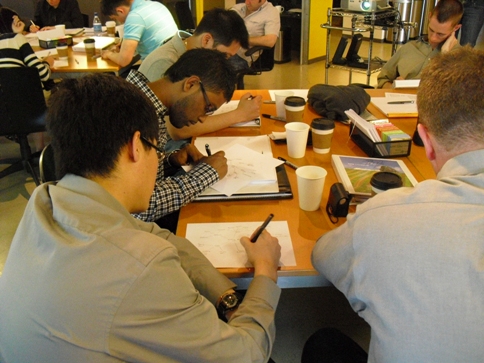
Rotman Students work to create mindmaps of their thoughts on health and health care
You know more than you think you know. We often emphasize what we learn from secondary sources and from folks out in the real world. But we should remember that we already know a lot about almost any subject that we are going to tackle. Mindmaps help you quickly get out everything you already know in order to figure out where you are starting from and where you need to explore.
Rotman is in the Building!
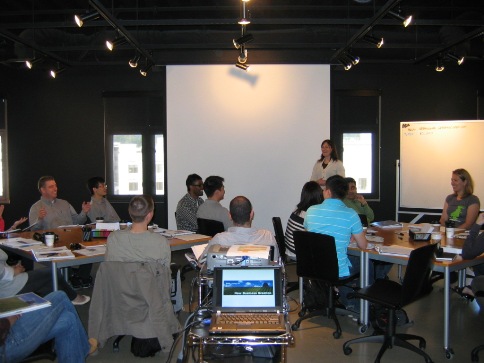
After flying in from Toronto this weekend, our friends from the Rotman School of Management have arrived at Jump! We spent the morning introducing the MBA students to Jump, our work, and our design process for creating sustainable, high-growth businesses. Above, you’ll see a shot of our home base and lecture hall for the week – Jump’s performance space. We’ll also spend some time in the field, so we’ll be sure to share images from around the San Francisco Bay Area as they arrive.
Healthy Eating: Opportunity Abounds

While a portion of next week’s Learning Lab will involve teaching, we think that the best learning occurs when students are able to put concepts and methodologies into use immediately. We make sure that every Learning Lab at Jump is based on a real world project or problem that can be explored over the course of the time we have together.
In this case, we have a group of ambitious, bright, and passionate business students, and we want to take advantage of that intellectual horsepower. So we selected a big social problem, specifically healthy eating, and we’re going to consider how new businesses can be built to address this issue.
For many reasons, it seems that we are nearing the end of an era of where cheap, processed food ruled our eating habits. More and more, people are demanding fresher ingredients grown closer to home, and in ever-greater varieties. The recent recession has pushed many formerly affluent consumers to refocus on dinner parties and home cooking to satisfy their need for indulgence; some high-end restaurants have struggled. Looking around our cities, CSA boxes have become urban fixtures, gourmet street-food carts dot the landscape, and even agriculture and aqua-culture are on the rise within city limits. At the same time, many other urban residents continue to live in “food deserts,” a fancy name for neighborhoods that lack access to fresh produce of any kind.
Signs abound that every aspect of the food economy is changing dramatically in North America: meals at home, sit-down restaurants, quick-serve eateries, grocery stores, industrial farming, and on and on. Some of these changes are occurring during the production process, some during distribution and retail sales, and some finally during selection and consumption. All of these changes make us excited about the possibilities for new products, new services, and completely new businesses. And they make us really excited to try our hand at tackling them for an action-packed week of learning and doing.
The students come in on Sunday night, and we can’t wait to begin working on these big questions with them!
You are currently browsing the Jump Learning Lab blog archives.